

Let’s kill this thinking right out of the gate: heavy is not a number.
I’ve worked with clients whose own body weight was heavy for them. I’ve seen people new to barbell movements struggle with their first squat, even though their dumbbell squats were strong. It was heavy for them. I’ve also seen clients, and myself, load a bar to max effort weight that looked smooth and it still felt heavy AF.
Completely different experiences. All real. All valid. All heavy.
If you’ve been waiting to “lift heavy” until you can move a specific number, I’ve got good news: you’re already qualified.
Heavy isn’t a finish line. It’s a relationship between you and the weight, today, right now. And like any relationship, it keeps changing.
What “Heavy” Means for a Workout
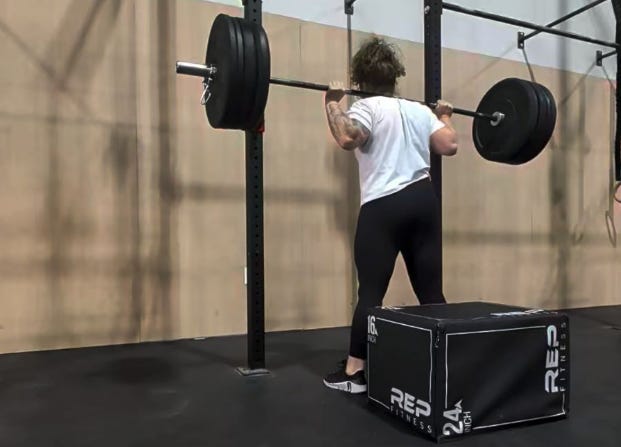
Heavy is relative intensity. It’s not about the absolute load. It’s how close that load pushes you against what you’re capable of, right now.
Here’s how I coach it: if your goal is to build muscle, growth comes through heavy compound movements, think 5 sets of 5 at a weight that feels heavy for you. This is where you build base strength and work capacity in the large muscle groups, which lets you handle more down the line.
You’ll know what feels heavy to you. If the weight scares you a little, that’s OK focus on technique and try. If it doesn’t move, don’t force it. Back off the weight and finish the workout.
The workout doesn’t end with the heavy compound lifts. Next come accessories, bodybuilding movements like rows, curls, RDLs, and pull-ups, in higher rep ranges, building the supporting muscles and strengthening your joints.
Something I learned from the Westside Barbell community: strength is built in the accessories. Your accessories shouldn’t be easy. The weight and reps should challenge you just as much as the main lifts, sometimes more.
Compound movements and accessories together make a full training session. One is not better than the other; both are necessary. If you don’t have an hour for both, split them: big muscle groups one day, accessories the next.
In the end, muscle grows because of mechanical tension, applied through repeated and progressively increased weight over time. That’s it. Something is better than nothing, and something heavy, done with strong form, is best.
Everything else (rep schemes, tempo, exercise selection) is the delivery system for that tension.
Learn to Listen to Your Body
This might be the most underdeveloped skill in the human race.
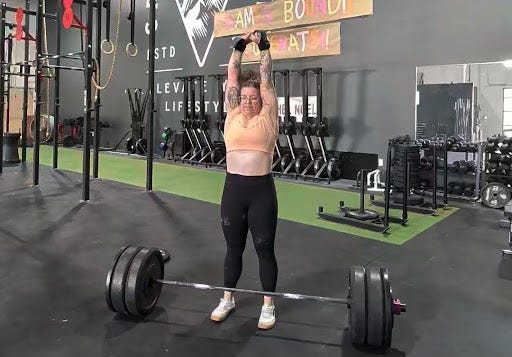
To know what “heavy” feels like, you have to listen to your body.
Forget metrics for a second. Forget reps and percentages. What does hard feel like?
It’s your breath changing: quiet, then audible, then ragged.
It’s the bar speed slowing on rep 5 when reps 1 through 3 flew up.
It’s your legs starting to twitch as you initiate a lift, and defying gravity anyway.
It’s the voice in your head asking do you have one more? and not being sure of the answer.
Most people never practice listening for that voice. They spend years either avoiding discomfort entirely, or gritting their teeth and blowing straight through every signal their body sends. Neither is the skill.
The skill of listening to your body is telling the difference between this is uncomfortable and this is dangerous, and that distinction only comes to life inside your own body reps.
Fighting through challenge isn’t blind grit. It’s staying present enough, the whole time, to know whether you’re pushing productively or just grinding yourself into the ground. That’s a skill you build in the gym, forged in iron, applicable to every part of life.
The Tactical Stuff. How to Do This.
1. Progressive overload, tracked.
Same lifts, once a week, logged every session. Add a little weight, a rep, a set every week. If you’re not writing it down, you’re guessing and calling it training.
2. Compound lifts first, accessories second.
Start with one squat, deadlift, press, and hinge movements for multiple heavy sets while you’re fresh. These are your highest ROI lifts, recruiting the most muscle and building the most tension per rep. Accessories come after: smaller, single-joint moves like curls, pushdowns, lateral raises, and ab work. Not filler; this is where you diversify. Accessories hit what the big lifts don’t, and it’s where a lot of the visible muscle-building happens.
3. Rest periods matter.
Take 2 to 3 minutes between heavy sets on big lifts. I don’t care if you’re bored; put something in your ears to listen to. Rest isn’t downtime, it’s part of the process: it lets your body and nervous system reset so you can hit the next set with the same intensity. Rush it and you’re wearing yourself down for nothing.
4. Get close to failure, don’t live there.
Most sets should end with something left, a rep or two you could’ve gotten if you had to. Grinding every set into the ground is a very fast way to burn out and get injured.
5. Deload every 4 to 6 weeks.
Planned lighter weeks aren’t a break from progress, they’re what makes long-term progress possible. Heavy lifting without a deload eventually turns into an injury or a wall you can’t get past.
6. Form under fatigue.
A heavy rep with ugly form is risky. If your technique falls apart to move the weight, you’re not getting the stimulus you need for the outcomes you want. Form first, always.
7. Don’t be afraid to ask for a spot.
If you don’t train with a crew, be ready to ask for a spot when you get into heavy work. Safety first, we’re here for the long game. It’s also a great way to make new friendships; the ripple effect of asking for that spot goes well past the lift itself.
Common Mistakes
This is the ego-based stuff where bad things happen. Let’s not…
Chase PRs. That mindset invites injury. You want base strength that holds, not a torn muscle that takes you out for weeks.
Skip the boring stuff. Warm-up sets, accessories, and mobility work are what let you load heavy safely for a long time.
Compare your heavy to someone else’s heavy. Building strength at any age, with any resource, is a win. Comparing your journey to someone else’s is a losing strategy every time.
The Point of All This
Heavy lifting isn’t about how much you can move once, on your best day, with everyone watching. Unless you are a powerlifter, but that’s a different article.
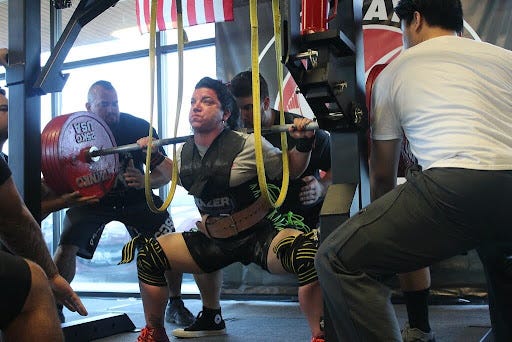
Heavy lifting builds strength, and strength is infrastructure. And that’s what heavy lifting is about for me.
Build it quietly, safely, session after session, so that thirty years from now you’re not frail. You don’t want to be the person who didn’t fight to get off the floor without help for as long as possible.
Be strong, on purpose, because you built it that way.
Strength is a life strategy.
Don’t die frail.
Work with Dana
If you’re reading this thinking I want this, but I don’t know where to start, that’s what coaching is for. I work with people one on one to build a lifting program around where you are today: your body, your schedule, your goals. No guesswork, no generic templates.
If you’re ready to stop waiting for the “right” time, weight, or health milestone to get started and want to build real strength, apply for coaching with WildeFit Coaching.
Reminder: The first five episodes of Muscle Moments and all companion content is available for free. After, all podcast episodes will remain free and other content will be made available to paid subscribers who make this work possible.
Enjoying Muscle Moments? Tell your friends and earn upgrades!
LOVE IT!