

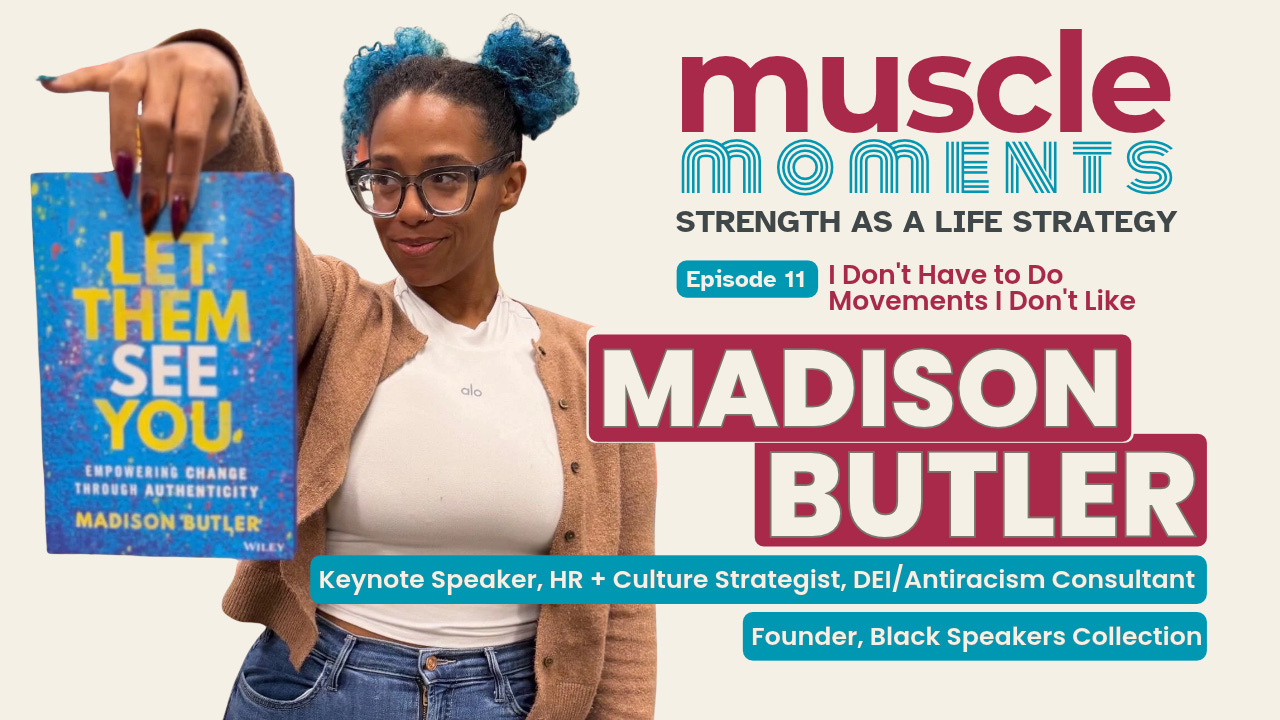
Madison Butler puts the gym on her calendar the same way she puts a meeting there; this isn’t a “maybe” or “if I have time.” It’s an agreement. A firm decision to take care of herself. A boundary that is clearly written out on her calendar, unavailable for anyone - including herself - to schedule over.
What Madison figured out between a ruptured knee and gaining one hundred pounds in a C-suite role is that a boundary you don’t stand on isn’t a boundary, it’s a suggestion. And nobody respects a suggestion. Not your boss. Not your friends. Not even you.
She didn’t gain weight skipping the gym because she didn’t have thirty to forty-five minutes. She had the time. She didn’t give herself permission to spend her time as a full person instead of solely being focused on her career. (For others out there, hear “career” as taking care of anyone else but yourself, first). So she stopped waiting for it, and created it.
On this episode we get into:
Softness isn’t the opposite of strength
How the boundaries practiced in the gym are the same boundaries needed at work
A knee injury that had doctors asking “have you tried working out?” and her pain labeled as psychosomatic
Eighty pounds down and then the body dysmorphia kicks in
Why you don’t “no show” on yourself
Strength Doesn’t Mean Everything Has to Be Hard
Most people define strength as a synonym for grit, the ability to do hard things in the face of all adversity. And it is. Madison, however, defines it like a permission slip.
“Strength is the reminder that I can do hard things. But it is also a reminder that I don’t have to.”
What? We’re allowed to say that part out loud? In the high-power-career life we talk a lot about capacity, same in the gym; what you can carry, how much you can take, how hard you can push. But we rarely talk about the strength it takes to put it down, to let go.
Madison connects this principle in her life to being a Black woman who was taught, explicitly and constantly, that resilience is the price of admission. That everything worth having gets earned the hard way, including rest. And she lived it for decades until she decided she was tired of being called resilient. Because being called resilient means something was supposed to break her and she’d rather nothing be trying to break her in the first place.
A lot of what Madison shares from her experience in this conversation offered me a new perspective. And a lightbulb moment I had during our talk was that yes, life is hard but it really doesn’t have to be. Have I really become numb to achieving “hard things” that I forgot life can be easy? Seems so. Bet you did, too.
We can set boundaries. And in holding those boundaries we show up for ourselves and watch the impact of keeping that promise spill over into other areas of life. We feel like it’s “easier said than done”, but it’s really just a belief we’re holding on to. Which also means, it’s something we can change. How inviting to know we can change. And how exciting to know we can use the gym as our testing ground to establish and hold boundaries!
The Gym is a Test Run for Every Boundary We Need
Madison learned to set boundaries in the gym because it’s low-stakes enough to practice with. She put her workout on her calendar like any client meeting, a non-negotiable. Not because she loved the discipline of it. Because she’d learned that if it wasn’t treated like something important, it would get treated like nothing by everyone.
“We all set boundaries, but if we don’t stand on them, they become a suggestion, and nobody cares about our suggestions.”
The same muscle she built holding her boundary to protect her gym time is the one she uses across all aspects of her life, especially her work. No, she can’t take notes for that meeting. No, she’s not planning the company party. No, she’s not getting on a call on a Saturday. Not to be difficult, because she already proved to herself, rep by rep, that she can hold a line, ask for what she wants (and deserves!), say the quiet part out loud, and survive the discomfort of it.
This is the result of trusting yourself to repeatedly do what’s best for you, first. You don’t build boundaries at work first. (Trust me, I’ve tried.) You build them outside the office and bring those lessons with you. In our case, we learned to build boundaries somewhere smaller and lower-risk, and then let them carry over. That place is the gym.
For me, it wasn’t even intentional, it just happened. I stopped expecting less from myself when I started keeping my promise to show up and train, and in turn I stopped expecting less from others, too. I forced myself to rise to a new standard. Some people took the invitation to rise with me. Others didn’t - that’s OK.
This isn’t something I consciously knew I was doing but after a lot of reflection I connected the dots across what I learned by not breaking my gym time promise, and how that helped me show up and rise to the occasion in all other areas of my life. It also taught me when something is worth hanging on to, and when it’s not.
Athlete, Then Professional, Then What?
Madison played soccer from the time she could walk through college and into competitive adult leagues. Her knee however, decided the soccer career would come to an end. Multiple MCL injuries. Then an ACL tear so violent it included a fractured bone. Years later, a second ACL tear because the first surgery used the wrong size graft. (YAY! Thanks, Doc.)
While dealing with all of that, work consumed the rest of her. Not just her schedule, her actual self, all of her. She gained one-hundred pounds because she stopped having interests that existed outside of her career, and her body paid the price.
Getting into the gym again wasn’t about getting her 22-year-old athlete-self back. It couldn’t be, because as much as she hates to admit it, she’s not that athlete she is anymore. And chasing that ghost is exactly what she says nearly cost her the joy of fitness and movement entirely.
So she built something new:
“I don’t have to do movements I don’t like... I’m never gonna be the coach that’s like, go do 1,000 burpees, and if you hate it, good.”
Demonstrating in the gym for herself and her clients*, and daily life, the wisdom she learned as a young athlete, a full time badass career woman, and a part-time gym girlie today.
*Nowadays, Madison considers herself a part time gym girlie. She loves the gym and it’s impact so much, she is also a part time trainer helping career-focused people take what they learn about themselves in the gym back to the office.
More To Know About Madison
She’ll never give up Diet Coke. Ever.
Her go-to lifting song right now is “She Bang” by Drake
She describes herself as “a hater” who has built one of the most authentic communities on the internet.
She also believes the gym is a community without having to socialize.
“Everyone’s rooting for you. Nobody needs your name. You just need someone willing to spot you and pull the bar off you if it falls.”
Your Turn
Where in your own life have you been treating a boundary like a suggestion? Waiting for someone else to respect so you feel like it matters?
ABOUT MADISON BUTLER
Madison Butler is known to many as the Blue Haired Unicorn. She is a keynote speaker, HR and culture strategist, and DEI consultant who’s built her public voice around having the hard conversations workplaces like to avoid.
There’s a piece of her story that doesn’t often come up in her presentations: a knee reconstruction, a doctor who told her she’d never run, jump, or play sports again, and a lengthy recovery where she got to prove him wrong.
Madison has also spoken publicly about how Black patients often have to fight to be heard and treated well by medical professionals. Which means her recovery wasn’t just physical, it was the same fight she’s built her career around, but showing up in a doctor’s office instead of a boardroom.
Through all of this, she made the connection for herself and for her clients that the brain and body are a single unit, and they work together in all facets.
GET IN TOUCH
LinkedIn: linkedin.com/in/bluehairedunicorn
Facebook: facebook.com/BlueHairedUnicorn
Instagram: www.instagram.com/madisonameliab
Website: bluehairedunicorn.com


